Into the Dark Together

Recently, after getting a haircut in Ballard, I crossed the street to chat with a friendly-looking woman in sage linen overalls tending the Nordic Museum’s beds. I asked her about the BBB, the bronze birch borer (Agrilus anxius) which is feasting on Seattle’s birch population, with a specific appetite for the non-native, white-barked varieties.

Damage appears first at the crown, defoliating the limbs. One of the birches near the museum sign looked stricken, and the gardener confirmed it, explaining that crown die back and the “D” shaped exit holes on the trunk are signs that tree is a goner.

I told her about the betula Jaquemonti we planted as a sapling when we bought our house thirty years ago. Now two to three stories tall, it gives us shade, kindling, catkins, compost, and habitat for birds, squirrels, and small humans. So far it appears healthy, but our neighbors’ birches are balding up top.

Drought weakens the trees natural defenses, she said. She didn’t have to mention the hottest temperatures ever recorded on the planet, and what they bode for our future. I recognize climate anxiety when I see it.

Will a future Seattle, once known for our mild climate, become a refugee city? Will drought and infestations leave the city’s tree canopy with brittle snags, lush gardens replaced with Himalayan blackberry vines? Will we see generations of Droplets in the city’s red cedars? Seattle has lost 255 acres of tree canopy in the last five years.

Dark thoughts swirled as I entered the museum, made darker by the news on my iPhone that the Titan’s passengers had been alerted to their imminent death before imploding. WTH? Why was an alarm made to sound when the hull was breached, prompting them to offload weight so they could surface, when such efforts were futile? As I tried to parse the engineers’ logic, the corollary with climate change was impossible to ignore.

When is no alarm the most compassionate?

I checked in at the museum’s reception desk, palmed my ticket, and pushed open double doors to the current installation, titled FLÓÐ (flood).

It was pitch dark. An overhead strobe gave brief glimpses of fog, a dark carpet, velvety walls. Discordant noises emerged from all sides: an industrial crash, freeway roars, whooshing wind and surf.

I blinked, willing my eyes to adjust, and reached for my glasses out of habit, but they were useless. I could not see my hand in front of my face. Inching forward, I became conscious of the clammy hand of fear at my neck.

Nothing to be afraid of, I consoled myself, swiveling to see the EXIT sign, a green glow in the fog. This is not the Hotel California. You can leave anytime you want.

But my body wasn’t having it.

It was trapped in a nightmare from childhood, stuck in a dark place, unable to escape. A therapist once suggested this was my brain processing birth trauma, which seems as likely as anything, but in that room, no doubt inspired by this podcast on epigenetics, I had a new thought. Maybe the nightmare is beneficial, in a sense, something encoded in my RNA by ancestors who had survived dark places. It is meant to alert me to get out while the getting is still good.

Is this from my Sámi ancestor who, for pummeling a Swede in a bar fight, was sentenced to a year in the medieval fortress at Varberg? Was this from my Finnish ancestor who found that the “land of the free” did not prevent mine bosses from sending him into danger ahead of the Swedes and Norwegians? Was it a gift from young Brita, blind in one eye, lying head to foot in steerage for the month-long voyage from Liverpool, her cloak wrapped tight against the fingers of chill winds and strange men?

Now the exit sign now looked like a life raft. As I shuffled toward the door, the strobe illuminated someone else in the room.

“Hi,” I whispered. “I am freaking out in here.”

“Well, sure,” she whispered back. “I still get scared, and I’m a docent.”

The kind docent consented to us holding hands and navigating the exhibit together. A problem shared is problem halved and a nightmare vanquished. When we emerged at last into the lighted hallway, we thanked one another, and spent a few minutes admiring the whimsical illustrations of The Whale Child that line the west wall. In a previous life, the docent was a children’s librarian, and she is very fond of this book by local authors.

It occurred to me that The Whale Child provides an answer to FLÓÐ.

“We are utterly screwed,” FLÓÐ seems to say. (Obviously, mileage varies.)

“We are all one in this great mystery,” says The Whale Child.

It’s an inspired pairing.

I wandered off to check on some permanent exhibits that are remarkable for what they do not say.

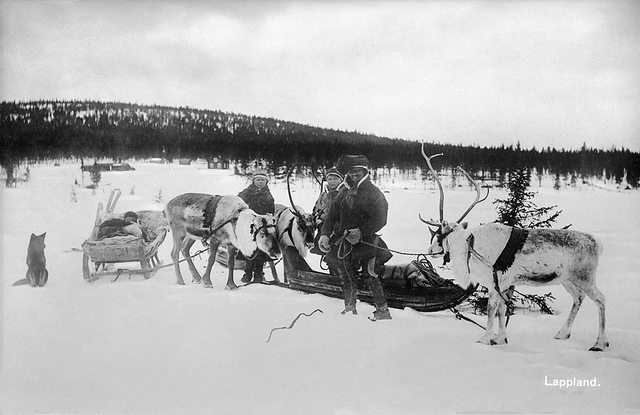
The first is a replica of a lappstrake / clinker–built boat, the second a mural of reindeer by a Swedish artist, and the third, a courtyard labyrinth by an Irish-American sculptor. You would never know it from the signage, but all three, lappstrake, reindeer, and labyrinth, have powerful symbolic and historical associations with the Sámi. Why nothing in the signage?

Is this a case of ye olde colonial erasure, or something else. Have the Sámi been ringing the alarm of climate change for so long that silence is considered a tender mercy? No, I thought, that can’t be. The museum has more Sámi programming than ever, and a new exhibit coming next month.

Go see FLÓÐ if you can (the exhibit is extended to August 6).

Try to find a hand to hold. We are in this together, whatever this is.
Linneaus, Punk’d

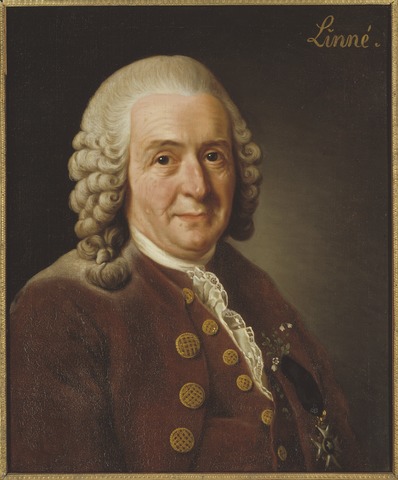
Carl von Linné, 1707-1778 by Roslin Alexander

I am inclined to believe that Linneaus was made fun of . . .

It is a well known fact that informants might get tired of the anthropologist’s endless and sometimes in their eyes nonsensical, questions. They then can tell the unhappy researcher what comes to their mind to satisfy him and to amuse themselves. I am inclined to believe that Linnaeus, too, was made fun of, without him being aware of it. After having been in Tjåmotis on his way back to Luleå, he describes, among many other things, the way the Sami kill a reindeer. He then mentions all the useful slaughter products the animal supplies them with. In the end we read: “Everyone throws the testicles away. The penis serves to make a thong to draw the sledges.

Though no comment is given on this, either in the general text commentaries or in the ethnological commentary on Linnaeus’ diary published in 2003, I have my suspicions that Linnaeus here was fooled. Although he told Roberg that he had travelled by sledge, no traces of it are found in the diary. The harness for drawing sledges he saw himself and described, when he was in Lycksele, had a leather thong. Motraye, who did travel by sledge and describes both sledge and harness, never mentions such a thing, talking only about “a trace”/”un trait”. From a publication of Knud Leem from 1767 we know that this thong was made of a strap of cow skin or seal skin, well greased to make it supple.

Nellejet Zorgdrager in Linnaeus as Ethnographer of Sami Culture, TijdSchrift voor Skandinavistiek vol. 29 (2008)

Jukkasjärvi Sámi family with sledge and reindeer, photo by unknown, Almquist & Cöster postcard 1949. Swedish Heritage Board. Public Domain

Longish Thoughts on Sámi Shorts

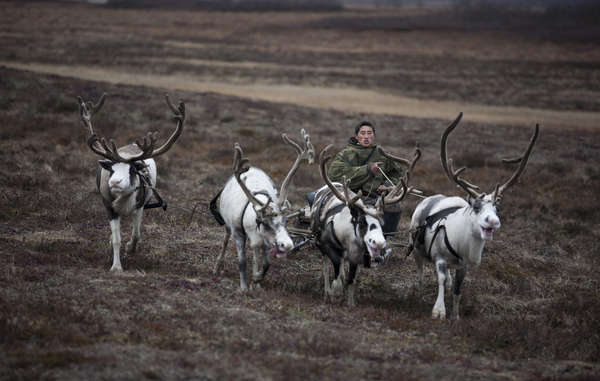
Lloyd Binder’s reindeer. Photo from Canadian Reindeer.

When Stina Cowan of the Nordic Heritage Museum asked if I would introduce the Sámi short films at SIFF’s 2014 Nordic Lights Film Festival, I didn’t hesitate. Two years ago, it was a SIFF screening of the documentary Suddenly Sámi that seeded the formation of Pacific Sámi Searvi and my personal journey of discovery. Since that time, there have been significant events for Sámi culture in our region, including a large duodji exhibit bringing artifacts and lecturers from the Ajtte Museum, the first local celebration of Sámi Day at Tacoma’s PLU, the first Sámi Grand Marshal and Sámi flag in Ballard’s Syttende Mai parade, the first “official” Sámi-American participation in Astoria’s Scandinavian Festival, and the first English translation of Emilie Demant-Hatt’s “With the Lapps in the High Mountains,” by local author and translator Barbara Sjoholm. Searvi members also rallied on behalf of Idle No More and Gallok.

It was exciting enough to have four Sámi-related films at SIFF; I did not expect a personal connection. Imagine my surprise on learning that the reindeer in Tundra Cowboy are my DNA cousin Lloyd Binder’s. While I haven’t met him in person (FamilyTreeDNA linked us), he was kind enough to answer my questions when I contacted him online.

Both Lloyd and his reindeer are descendants of the Yukon Relief Expedition of 1898, which brought Sámi herders and reindeer from Sápmi through Seattle up to Alaska. His maternal grandfather Mikkel Pulk joined the expedition in its second year, and in the 1930s, Mikkel and his wife Anna were recruited by the Canadian government to teach herding to the Inuits. The Pulks remained as herders for over 30 years. Their daughter Ellen, married Lloyd’s father, Otto, an Inuvialuit from Coppermine, N.W.T., now known as Kugluktuk (Otto also owned a herd for several years in the 1940s). Lloyd earned an economics degree from the University of Calgary and served as director of economic development and tourism for the Inuvik region before turning to herding. It’s in his blood.

Like his employee Henrik Seva (the subject of Tundra Cowboy), Lloyd is a man of dry wit. When I asked how he keeps the reindeer from mixing with the indigenous caribou, he responded: “vigilance.”

It is possible that I am also related to Henrik, as he and my grandfather were both born in Pajala Municipality in northern Sweden. The Sámi gene pool is small, even though, like the offspring of the Yukon Relief Expedition, it is dispersed over vast distances.

On the morning of the screening, the sun painted the sky pink and gold, and I feared that few people would show up for a Saturday matinee. SIFF attracts devoted cinephiles, but in Seattle, a rain-free January weekend must be taken seriously. There was standing room only in the theater, however; the shorts had a large and very appreciative audience.

Marja Bål Nango in Halvt ditt og halvt datt (Half of This, Half of That)

Of the three student works by Sámi filmmaker Marja Bål Nango, Halvt ditt og halvt datt (Half of This, Half of That) initially concerned me for its apparent equivalency (using a split screen) of a Sami gakti with a Norwegian bunad, both of which Nango is shown putting on and taking off. I wanted to protest: they aren’t the same! (e.g., the gakti is everyday wear while the bunad is a costume, for special occasions). Nango no doubt intended to provoke that response, as she deftly segués to more complex issues of self-identity. With a stark white background and tight focus on their youthful faces, she interviews several peers about self-identity, and you can watch their emotions shift as they struggle for words. It is powerfully intimate. While it features Norwegian citizens, the film has universal scope; asking if language is essential to identity and what it means to be “half of this, half of that” or “part” anything. I found myself thinking several times of the exhibit about race at the Pacific Science Center. This short would make an excellent addition to it.

Scene from Juletrollet

Nango’s second film, Juletrollet (The Christmas Troll), depicts a Sàmi girl envious of her Norwegian playmate’s Christmas tree. The playmate is curious about Sàmi customs, but whether her questions are benign or condescending isn’t clear. Verging on melodrama, the story is redeemed by a final scene in which the friends perch outside in the dark, singing to the stars. Nango’s characters finds serenity in a holiday that promises more than it delivers.

Still from “Before She Came, After He Left”

My favorite of her three shorts, Før Hun Kom, Etter Han Dro (Before She Came and After He Left), was filmed in an impossibly beautiful fjord. The winter chill is palpable; noses drip, boots crunch. After the tragic death of a boyhood friend (who may have also been a lover), a young father is tormented by grief, and his fiance is confused and concerned. Inner landscapes are revealed in flashbacks and small gestures, and the visual lyricism carries multiple layers of meaning, like the work of Akiri Kurosawa. I hope it gets a wide audience. (Check out Nango’s most recent collaboration, Indestructible.)

Amazing flying machine from “Tundra Cowboy”

With a faster pace and frank documentary style, Tundra Cowboy saturates each of its 18 minutes; the story of Henrik Seva unfolds energetically and economically. The blood and guts of reindeer slaughter are candid without becoming grotesque, the wide pans of the reindeer are thrilling but stop short of cliché, and a convivial springtime calf-marking in Sweden provides nuanced and colorful contrast to Henrik’s monochromatic, solitary life on the tundra. The heart of this story is Henrik’s motivations, which are rooted in loss and quietly heartbreaking. One of my favorite moments is when the camera rests on Henrik’s face as he stops speaking, and then stays there, allowing the viewer to meet him in the still space he treasures. A thoroughly enjoyable, multi-dimensional film. (The 18-minute short is available to rent or buy here.)

After the screening, several audience members approached with questions about the Sàmi, the shorts, and the searvi. As there was no time for a Q&A session (the theater needed to be cleared for the next film), I promised to write this post and include links as well notes from my phone conversation with Tundra Cowboy’s producer and director, Marc Winkler. If I am able to chat with Marja Bål Nango, I’ll post again.

Marc is a Canadian journalist for CBC who lives in Yellowknife, N.W.T. with his wife and two daughters. Tundra Cowboy is his first documentary. Prior to meeting Henrik Seva in Inuvik in 2002, he had never heard of the Sàmi.

Left to right: Cinematographer Luke Eberl, Henrik Seva, Director Marc Winkler

What inspired you to make the movie?

My fascination with living in isolation like that, and knowing Henrik. He seemed like such a grounded person and I thought it might have something to do with having so much time for his thoughts. I wanted to talk to him about that. Although he uses a lot of technology, his pace, his everyday life is very different.

Do you think his groundedness is due to that?

Slightly. He does have a lot of time to mull over things, and time to explore his relationship with his reindeer. That is what he loves, caring for reindeer; I found that connection fascinating. He sings to the reindeer — and there are all these Sami traditions (connected to herding). The fact that he would travel all the way to Canada to maintain that connection . . . that says something! His grandfather, a herder, is his hero. He found a way to recreate his grandfather’s connection to reindeer.

Doesn’t he get lonely?

Sometimes he wants to see people and he does go to the town every 10 days for “R & R.” He was recently married, since the filming. He’s not a hermit!

How was it to film there?

It was really cold, minus 40 outside, with huge winds all the time. The camera batteries kept freezing. But it was beautiful! The tundra is a magical place and so peaceful. Henrik was patient with us, although he was busy herding. We were glad he took so much time.

Did he joik for you?

Yes, it was a very important thing for him to do. He was pretty shy about it, but he gave us the little example in the movie. For me it illustrates the beautiful connection he has with the reindeer. It is a love song, and it has the practical benefit of making the reindeer used to his voice.

What was left on the cutting room floor that you wish you could have included?

So much! The film was as long as an hour, and I got it down to 18 minutes. I wanted it to be subtle and focused. There are so many other elements that I tried to puzzle in there, such as the way colonization affected the Sami culture. Like the residential schools here (in Canada), there were government schools in northern Sweden. Henrik was sent to one, and he was punished for speaking Sami. He was not allowed to eat the food he was accustomed to. Reindeer herders were looked own on. He underwent ten years of assimilation, and it was a struggle for him; he felt divided over who he was and whether his culture was worthy or not. It is such a worthwhile project to explore . . . but that is another movie.

Also, the whole land and environment issues in Northern Sweden, the forestry and mining projects that are pushing herding into smaller and smaller places. If things keep going like this, it will not be a viable livelihood. In the 1920’s, the government was going to take away their rights to hunt, fish, and herd. Henrik’s grandfather made a deal with the king that they would herd but not fish and hunt. Others could fish and hunt, but not herd. So not all Sami are treated equally.

What are you working on now?

I just had a new daughter so I’m taking a break right now, but some any ideas have come up from doing this. Many different ideas, but nothing solid yet.

Marc and I talked a while longer about the Sàmi and the environmental issues that threaten reindeer herding — forestry, mining, and mineral extraction. I hope his success with this first documentary inspires many more.

The reindeer people under threat this Christmas – Survival International

In pictures: The reindeer people under threat this Christmas - Survival International

Survival International has published a seasonal picture gallery to emphasize the reindeer’s key role in the lives of the world’s northern tribes.

Survival’s Director Stephen Corry said today, ‘For many people around the world, reindeer are synonymous with the festive season. Few of us know, perhaps, that for various northern tribes the animal is integral to their survival and their human story. It is a great tragedy that the burgeoning Arctic extractive industry is exacting such a heavy toll on reindeers and their herders alike.’

via In pictures: The reindeer people under threat this Christmas – Survival International.

And from Greenpeace International:

Please help us to defend the rights of Indigenous Peoples of Russia!
One day before the opening of the Arctic Council meeting in Sweden, Russian authorities moved to suspend the activities of RAIPON (Russian Association of Indigenous Peoples of the North), the country’s main organisation representing the Indigenous Peoples. Basing their decision on an interpretation of inconsistencies in the organisation’s bylaws, this seems to be a thinly veiled attempt by the Russian government to silence the voices of Indigenous Peoples who are speaking out against the dangers of drilling for oil in the Russian Arctic.

But we have an opportunity here: YOU have the power to stop this censorship.

Let’s flood Russian President Putin’s inbox with millions of letters, expressing our deep concern about the suspension of RAIPON. We must remind the President of the vital importance of Indigenous Peoples’ voices in the legitimate political process around the Arctic, both in Russia and on the international stage. Make any changes you want to the letter, sign it, and send! And then forward on to everyone you know. Together we can defend the Arctic and the rights of its people!

Please sign the petition here.