
The “oldest shoe in Norway,” presumed to be of reindeer skin, was found in 2006 preserved in a snowdrift and recently re-estimated to be 3,400 years old. Three thousand years is a long time to innovate (if you live near Toronto, visit the Shoe Museum to see some of those innovations), but in 1916, when Ernest Shackleton and his team set out for the South Pole, they relied on boots and sleeping bags of reindeer skin, custom-made in Norway. The old technology would have served them very well, had they been able to stay dry. Shackelton wrote that by the end of the trek, water had ruined their sleeping bags, leaving them bald of fur, and his men resorted to wrapping their boots with rope to add tread.
With over two million dollars and many years of planning, the Shackleton voyage was recently replicated, right down to the reindeer skin, by Australian adventurer Tim Jarvis and British mountaineer Barry Gray, who reached their destination on February 10, 2013. It will be interesting to find out if they had better luck keeping dry.
What qualities of reindeer hide make it particularly useful on ice? Emma Winka of Tärnaby, Sweden, reminisces:
“The winter shoes were made from hide that still had the hair on. That made the shoes warmer and the hair on the bottom made the shoes less slippery in the snow. That’s why winter shoes were sewn a bit differently than the summer shoes. On a winter shoe there was a seam across the bottom of the sole. The hair on the front part of the sole pointed back and the hair on the back of the sole pointed front. That way the shoes got a good grip when you walked in the snow and you didn’t slip. There was another difference between the winter shoes and the spring-summer shoes. The winter shoes had a little point at the toe that stuck up. All the winter shoes except shoes for very small children had that little point that stuck up. That point was to help hold skis to your foot if you went skiing. Skis in those days had bindings that were like loops and if you had shoes with a little point that stuck up at the toe, that loop-binding wouldn’t slip off.” (Read more here: An Interiew with Emma Winka)
Desiree Koslin writes in her paper (pdf) on gakti:
“There are dozens of terms that specify reindeer and reindeer skins in the categories of their age, sex, color, the time of year they were slaughtered, which part of the animal the skin comes from, the type of tanning and fat used for preserving the skin. Each type has specific uses in the making of clothing and footwear. The making of a pair of winter boots, gállot, require two head skins and four leg skins.”Sámi shoemakers were women, and they prepared their materials with expertise and discernment. They would have been present at the slaughter to select the best skins for good color and strength. Above all, they harvested the sinew for their sewing needs, from along the spine and the back of the legs. After cleaning, drying and softening, they were twisted and doubled. The sinew swells when wet, and maintains a leak-proof seam. Stab stitch, over casting, felled seam, and placing welts of cloth in the seams are techniques used for different parts of the garments or shoes.”
To see shoes being made, check out this video.
Below is a photo from the “8 Seasons in Sapmi” exhibit at the Nordic Heritage Museum in 2012.

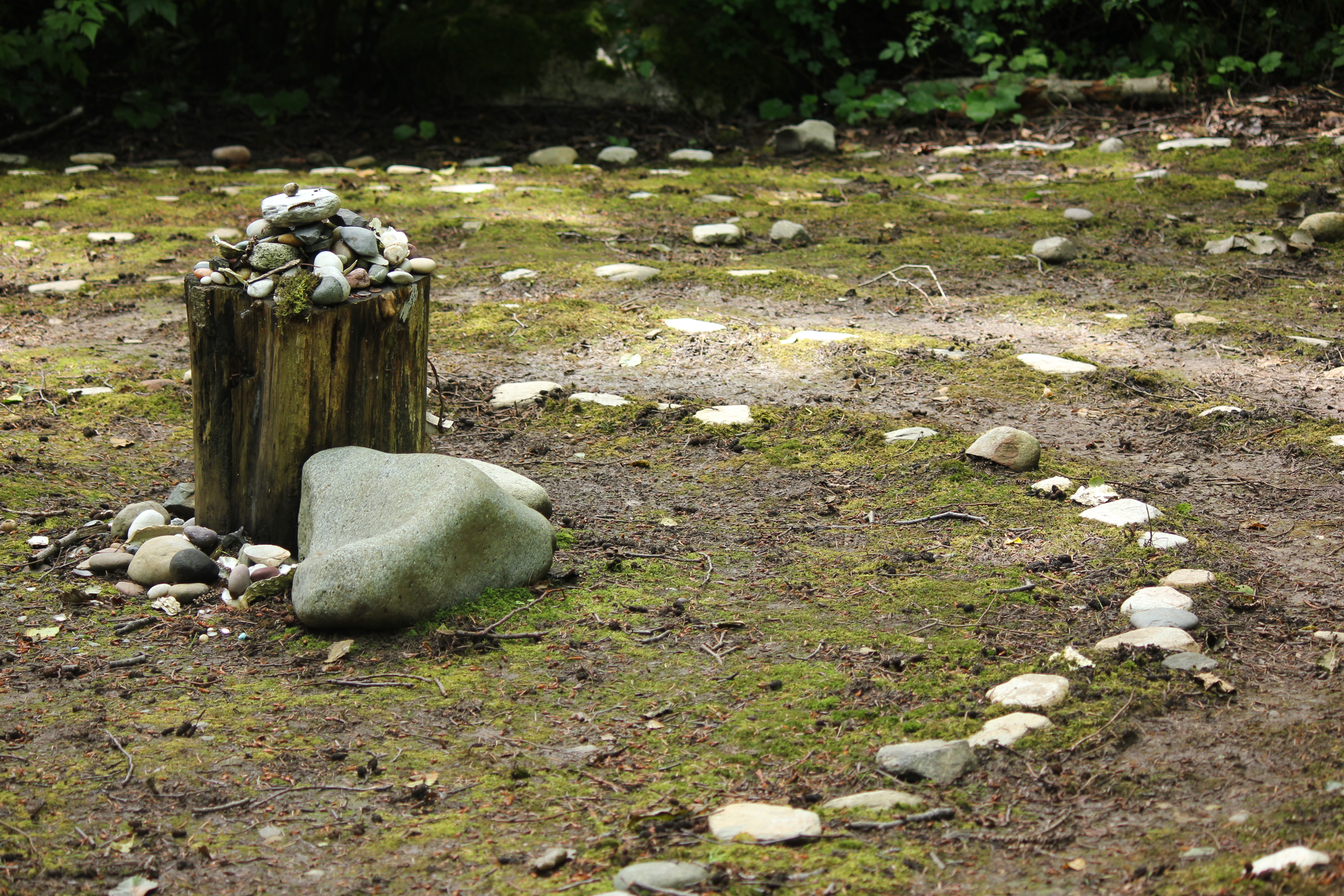 I’m taking a fascinating free, online class through the University of Toronto called Aboriginal Worldviews and Education. One of our first assignments was to write about a “meaningful place.” It was hard to settle on one, as there are so many within shouting distance, but I decided to write about a remote stone labyrinth where (in which?) I have walked in contemplation and more recently, in grief. The labyrinth is located on an island north of Seattle, a place that I came to know through two friends who lived there, a married couple who became, over the years, like surrogate parents (he shared my Finnish and Sámi heritage, she my passion for books and lost causes). Last year they passed away within a few months of each other, and were buried in the cemetery near the labyrinth, behind a storybook white-steepled church.


 Check out this
 Seattle Sámi