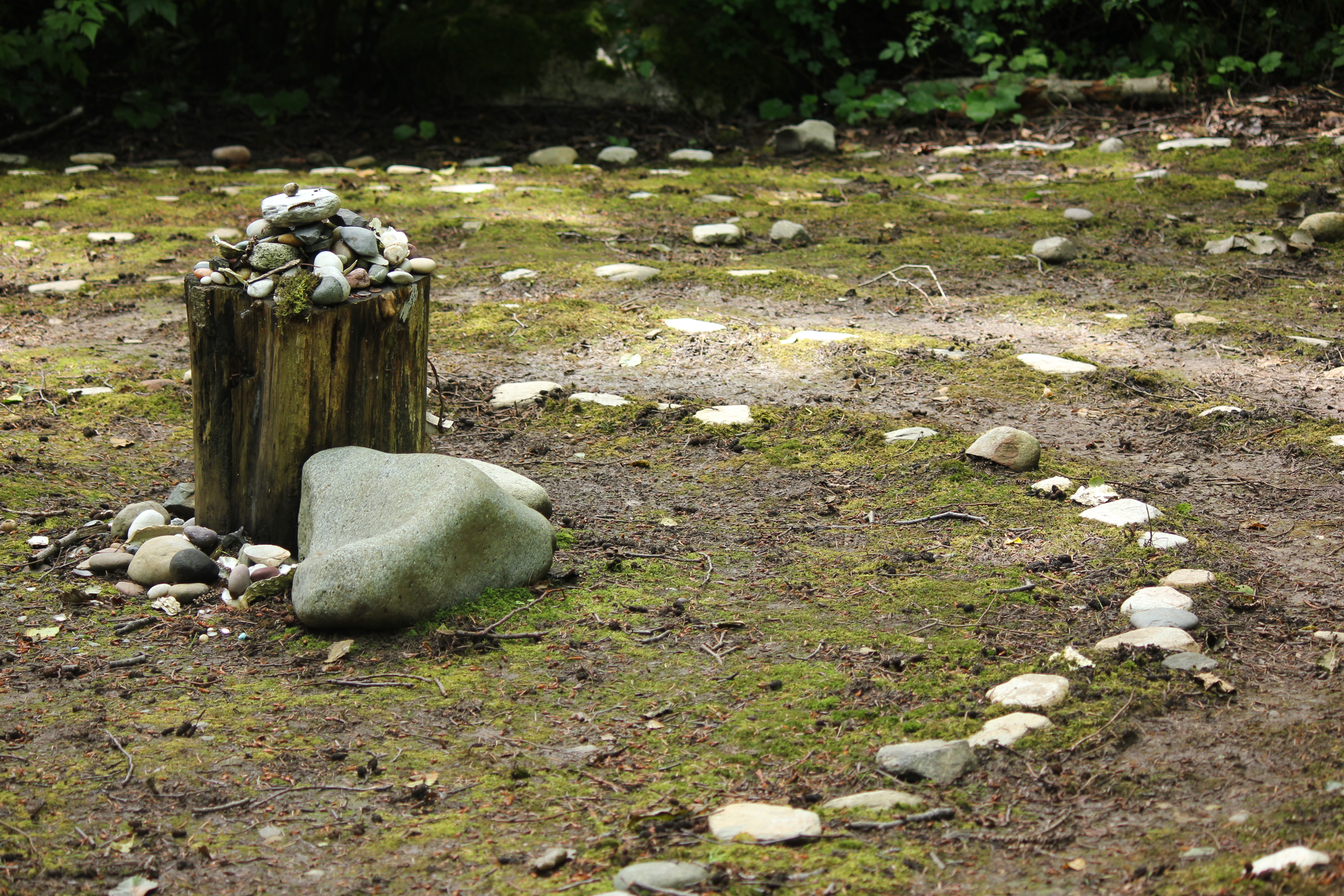
 I’m taking a fascinating free, online class through the University of Toronto called Aboriginal Worldviews and Education. One of our first assignments was to write about a “meaningful place.” It was hard to settle on one, as there are so many within shouting distance, but I decided to write about a remote stone labyrinth where (in which?) I have walked in contemplation and more recently, in grief. The labyrinth is located on an island north of Seattle, a place that I came to know through two friends who lived there, a married couple who became, over the years, like surrogate parents (he shared my Finnish and Sámi heritage, she my passion for books and lost causes). Last year they passed away within a few months of each other, and were buried in the cemetery near the labyrinth, behind a storybook white-steepled church.
When I visit, I park my bike near the church and walk through the woods to the labyrinth under a canopy of Douglas fir and maple trees. In the distance there is the sound of the surf, and rain or shine, you can smell the salty air. It’s a beautiful place.

The tradition I learned on the island was to bring a pebble to leave in the middle of the labyrinth. For the bereaved, or at least for me, this is a helpful ritual of laying down one’s burden of grief before returning to the everyday.
Unlike a maze, the circles of a labyrinth contain only one path, with no dead ends. The way in is the way out, and the simple act of concentrating on your next step is calming. I prefer to walk alone, although walking with others requires you to synchronize your pace, so that no one is lingering or rushing, and that too is meditative.


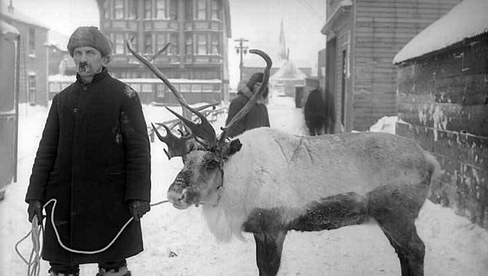
 Seattle Sámi