
Recently, after getting a haircut in Ballard, I crossed the street to chat with a friendly-looking woman in sage linen overalls tending the Nordic Museum’s beds. I asked her about the BBB, the bronze birch borer (Agrilus anxius) which is feasting on Seattle’s birch population, with a specific appetite for the non-native, white-barked varieties.
Damage appears first at the crown, defoliating the limbs. One of the birches near the museum sign looked stricken, and the gardener confirmed it, explaining that crown die back and the “D” shaped exit holes on the trunk are signs that tree is a goner.

I told her about the betula Jaquemonti we planted as a sapling when we bought our house thirty years ago. Now two to three stories tall, it gives us shade, kindling, catkins, compost, and habitat for birds, squirrels, and small humans. So far it appears healthy, but our neighbors’ birches are balding up top.
Drought weakens the trees natural defenses, she said. She didn’t have to mention the hottest temperatures ever recorded on the planet, and what they bode for our future. I recognize climate anxiety when I see it.
Will a future Seattle, once known for our mild climate, become a refugee city? Will drought and infestations leave the city’s tree canopy with brittle snags, lush gardens replaced with Himalayan blackberry vines? Will we see generations of Droplets in the city’s red cedars? Seattle has lost 255 acres of tree canopy in the last five years.
Dark thoughts swirled as I entered the museum, made darker by the news on my iPhone that the Titan’s passengers had been alerted to their imminent death before imploding. WTH? Why was an alarm made to sound when the hull was breached, prompting them to offload weight so they could surface, when such efforts were futile? As I tried to parse the engineers’ logic, the corollary with climate change was impossible to ignore.
When is no alarm the most compassionate?
I checked in at the museum’s reception desk, palmed my ticket, and pushed open double doors to the current installation, titled FLÓÐ (flood).
It was pitch dark. An overhead strobe gave brief glimpses of fog, a dark carpet, velvety walls. Discordant noises emerged from all sides: an industrial crash, freeway roars, whooshing wind and surf.
I blinked, willing my eyes to adjust, and reached for my glasses out of habit, but they were useless. I could not see my hand in front of my face. Inching forward, I became conscious of the clammy hand of fear at my neck.
Nothing to be afraid of, I consoled myself, swiveling to see the EXIT sign, a green glow in the fog. This is not the Hotel California. You can leave anytime you want.
But my body wasn’t having it.
It was trapped in a nightmare from childhood, stuck in a dark place, unable to escape. A therapist once suggested this was my brain processing birth trauma, which seems as likely as anything, but in that room, no doubt inspired by this podcast on epigenetics, I had a new thought. Maybe the nightmare is beneficial, in a sense, something encoded in my RNA by ancestors who had survived dark places. It is meant to alert me to get out while the getting is still good.
Is this from my Sámi ancestor who, for pummeling a Swede in a bar fight, was sentenced to a year in the medieval fortress at Varberg? Was this from my Finnish ancestor who found that the “land of the free” did not prevent mine bosses from sending him into danger ahead of the Swedes and Norwegians? Was it a gift from young Brita, blind in one eye, lying head to foot in steerage for the month-long voyage from Liverpool, her cloak wrapped tight against the fingers of chill winds and strange men?
Now the exit sign now looked like a life raft. As I shuffled toward the door, the strobe illuminated someone else in the room.
“Hi,” I whispered. “I am freaking out in here.”
“Well, sure,” she whispered back. “I still get scared, and I’m a docent.”

The kind docent consented to us holding hands and navigating the exhibit together. A problem shared is problem halved and a nightmare vanquished. When we emerged at last into the lighted hallway, we thanked one another, and spent a few minutes admiring the whimsical illustrations of The Whale Child that line the west wall. In a previous life, the docent was a children’s librarian, and she is very fond of this book by local authors.
It occurred to me that The Whale Child provides an answer to FLÓÐ.
“We are utterly screwed,” FLÓÐ seems to say. (Obviously, mileage varies.)
“We are all one in this great mystery,” says The Whale Child.
It’s an inspired pairing.
I wandered off to check on some permanent exhibits that are remarkable for what they do not say.
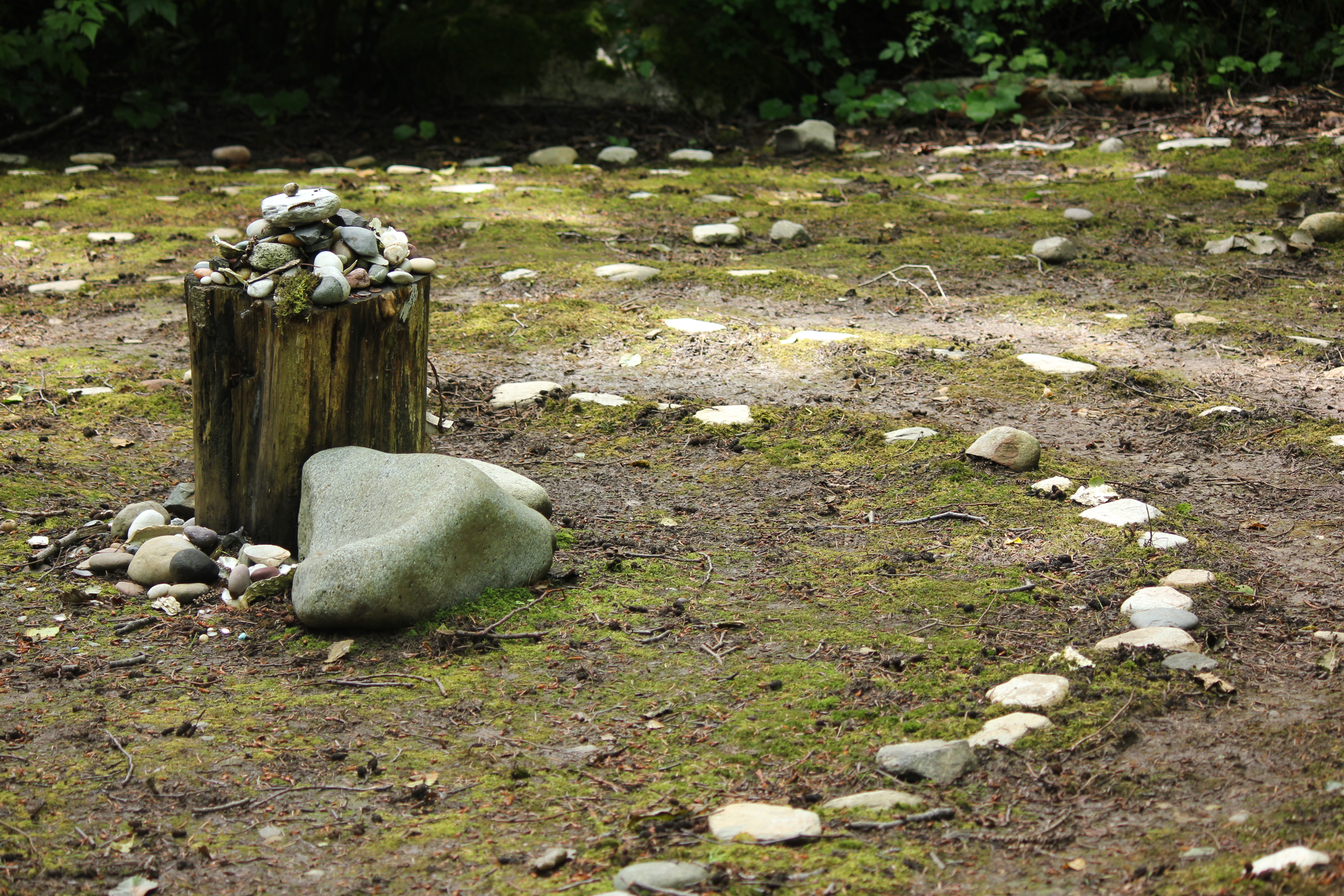
The first is a replica of a lappstrake / clinker–built boat, the second a mural of reindeer by a Swedish artist, and the third, a courtyard labyrinth by an Irish-American sculptor. You would never know it from the signage, but all three, lappstrake, reindeer, and labyrinth, have powerful symbolic and historical associations with the Sámi. Why nothing in the signage?

Is this a case of ye olde colonial erasure, or something else. Have the Sámi been ringing the alarm of climate change for so long that silence is considered a tender mercy? No, I thought, that can’t be. The museum has more Sámi programming than ever, and a new exhibit coming next month.
Go see FLÓÐ if you can (the exhibit is extended to August 6).
Try to find a hand to hold. We are in this together, whatever this is.

 Seattle Sámi