Lapland, From Icy Plunge to Blazing Sky

Check out this love letter to Sapmi in the New York Times. The story is in the travel section so I didn’t have high expectations, but it would have been nice to read more than one sentence about the Sámi: Early excavations suggest that this part of Lapland was inhabited as long as 11,300 years ago by the native ancestors of the Sami indigenous people, who still herd reindeer and eke out a living in the northernmost parts of Finland.”

We entered the hut, which had one changing room with a wood fireplace, and a larger sauna room. Then we set about roasting ourselves, ice-hole bathing, roasting and snow-angel-making in a cycle of extreme temperature change that Finns, and some controlled studies, say is good for the health.

Sitting in a bar that night, one of the men in our group remarked, “This whole country is about being either too hot or too cold.”

The next night, whole swaths of the sky danced with brilliant greens, purples and reds. Inside the curving, billowing, twisting streaks, the action was psychedelic. Tiny ripples, hundreds in parallel, danced like the light of a plasma lamp but with more variations of color and movement. What was green one second flashed to red, translucent and miles long. A streak that ran from horizon to horizon might phase out, then reappear at another location, or bend into the shape of an oxbow and spring back.

Finnish legend says that the lights are formed by a giant arctic fox running so quickly its tail sends plumes of snow from the fells, glittering across the night sky. It’s an unbelievable explanation for an unbelievable phenomenon that somehow smacks of truth

Finnish legend or Sámi legend? The Finnish word for the lights, revontulet, means foxfire, and is said here to come from a Sámi myth.
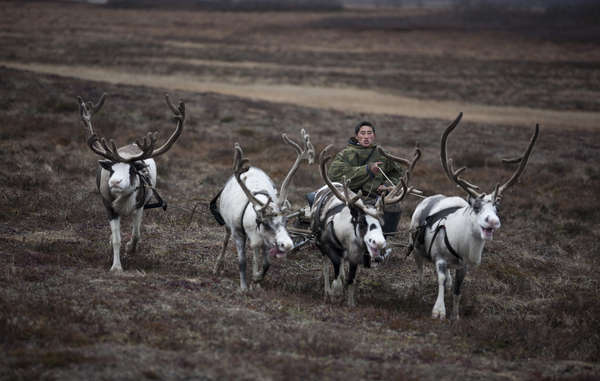
The reindeer people under threat this Christmas – Survival International

In pictures: The reindeer people under threat this Christmas - Survival International

Survival International has published a seasonal picture gallery to emphasize the reindeer’s key role in the lives of the world’s northern tribes.

Survival’s Director Stephen Corry said today, ‘For many people around the world, reindeer are synonymous with the festive season. Few of us know, perhaps, that for various northern tribes the animal is integral to their survival and their human story. It is a great tragedy that the burgeoning Arctic extractive industry is exacting such a heavy toll on reindeers and their herders alike.’

via In pictures: The reindeer people under threat this Christmas – Survival International.

And from Greenpeace International:

Please help us to defend the rights of Indigenous Peoples of Russia!
One day before the opening of the Arctic Council meeting in Sweden, Russian authorities moved to suspend the activities of RAIPON (Russian Association of Indigenous Peoples of the North), the country’s main organisation representing the Indigenous Peoples. Basing their decision on an interpretation of inconsistencies in the organisation’s bylaws, this seems to be a thinly veiled attempt by the Russian government to silence the voices of Indigenous Peoples who are speaking out against the dangers of drilling for oil in the Russian Arctic.

But we have an opportunity here: YOU have the power to stop this censorship.

Let’s flood Russian President Putin’s inbox with millions of letters, expressing our deep concern about the suspension of RAIPON. We must remind the President of the vital importance of Indigenous Peoples’ voices in the legitimate political process around the Arctic, both in Russia and on the international stage. Make any changes you want to the letter, sign it, and send! And then forward on to everyone you know. Together we can defend the Arctic and the rights of its people!

Please sign the petition here.

Ancient Origins of Yule

Recently I was asked to create a small exhibit at the Swedish Cultural Center to illustrate the ancient origins of Scandinavian Christmas traditions. Below are the tidbits I pulled together (only a few of which made it into the display). The objects in the display, owned by the Center, include beautiful weavings and Yule decorations such as a Julbok, a cheese press marked with an “x” to keep away evil, and a Christmas porridge bowl.

Update: There is a fascinating account of Christmas traditions in Sàpmi here, and an exploration along of pagan Yule traditions from a Norwegian perspective here.

Are any of these surprising to you? Do you have any corrections or additions? Please let me know in the comments.

Date of Christmas
For the church’s first three centuries, Christmas wasn’t in December—or on the calendar at all. December 25th already hosted two other festivals: natalis solis invicti (the Roman “birth of the unconquered sun”), and the birthday of Mithras, the “Sun of Righteousness.” The winter solstice, another celebration of the sun, fell within a few days. Roman church leaders decided to take advantage of the popularity of this season when they chose the date to celebrate Christ’s birth, an event that probably occurred in the month of September.

Continue reading