Crystalline prose that reads like poetry and myth at once. There are intricate layers of beauty and meaning here in sparse clusters across a vast new landscape as I’ve never read before. The music of this book is old, and it is new, and it is old.
Tommy Orange, There, There and Wandering Stars
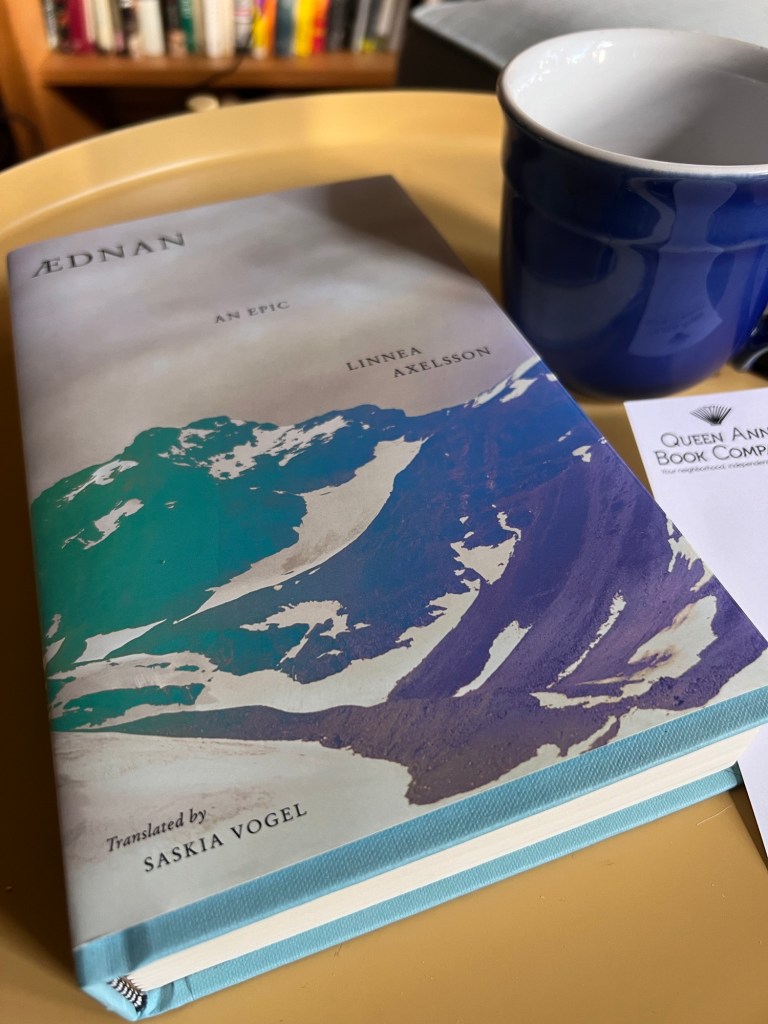
Since it was published in Sweden five years ago, I have been eager to read Linnea Axelsson’s much-celebrated Ædnan, so I was thrilled to receive it as a birthday gift this week.
It was nicely timed; the author will be signing books in Seattle next Monday.
Check out her golden Washington Post review.
The title Ædnan is an old North Sámi word for earth, land, mother, and woman. It shares the same root as eatnat, meaning much, a lot, great (from Proto-Samic eanëkën). I love how this one word holds the key to the Indigenous worldview, grounded in the experience of nature: as source, mother, abundance.
It occurs to me that Land Back, which has several meanings, is a call for universal rematriation. In Isaac Murdoch’s words, “people returning back and finding their place in those systems of life.” (Sadly the term still seems to activate more fear than understanding. Perhaps it could be reframed as Operation Prosperity Guardian?!)
I also love how eadnán appears so frequently in Sámi songs and poems, a few of which I have had the privilege of translating, most recently Mari Boine’s ballad Eadnán bákti (a Sámi poem by Kerttu Vuolab). “To Woman” is the English title.
Translating is always transcreating; in the process a new creature emerges, and one hopes it will fly. Sometimes the English words look like wings, sometimes like a clumsy giella (the Sámi word for both language and snare).
A bit like stuffing a fluttering, iridescent-feathered bird in a beat up old box that was designed for commerce, sports, or conquest. As some kid somewhere is intent on associating that box with farts in the Urban Dictionary.
I am consoled by the idea that my Sámi ancestors perceived language itself as the giella. The trap. After all, communication precedes and transcends words; it flows continuously through and between and inside and around us. Even in silence.
Ædnan contains a lot of silence. The physical heft of the book is not from ink, but from its snowy fields and margins. Evocative of Sápmi at this time of year.
I am eager to see how the book’s translator chose her snares. (I have bookmarked here her post about the process.)
If you read Ædnan, please let me know what you think.
Other local-ish events of interest:
Sámi Film Festival, with guest curator Lisolette Wajstedt, Seattle and online, Feb. 8-11
Vástádus eana – The answer is land Elle Sofe Sara in Vancouver, BC , Feb. 23-24
Wishing you a happy Sámi álbmotbeaivi next week.
Stay warm!

 Seattle Sámi