How Heavy the Heart

In the latest episode of the popular Swedish TV show Ällt för Sverige (All for Sweden), the show makes a rare visit to Sápmi. The contestants meet reindeer herders and reindeer, sleep in a lávvu, taste suovas, experience joik, and measure the weight, in blueberries, of a smoked moose heart. This is only the third time the show has ventured north in its eleven seasons, so it’s a rare treat. While missing a Sámi American contestant (eliminated in the first episode), the episode goes beyond the expected stereotypes to touch on serious issues, including Sweden’s colonial history, the effect of wind turbines on reindeer, and the racism still faced by Sámi schoolkids. The show is now casting for its next season, and previous travel in Sweden is no longer a disqualifier. So if you aren’t camera-shy and can commit to six weeks of filming next May and June, apply by January 15, 2024.

Breaking the silence

I was moved to learn that Norwegian musician Stian Soli’s song MIHÁ (for which I provided English translations) is now part of a curriculum in Norway, assisting educators in raising awareness of sex abuse, as well as how to prevent it, and the value of reporting it. Much respect to Stian and his team and to Mona, whose courage in reporting inspired the song and set many reforms in motion.

Breaking the culture of silence was a major theme in Tystnaden i Sápmi (Silence in Sápmi), the 2022 film by director Lisolette Wajstedt that was screened at the Sámi Film Festival in Seattle. As a cofounder of the festival in 2018, I am delighted that Lisolette will be the guest curator next year.

Colonial histories

Some events of potential interest to readers:

  • 2 pm, Sunday, Dec 3, 2023: Hanna Pylväinen, author of The End of Drum Time, at the National Nordic Museum. To my knowledge, the first American novelist to explore the legacy of Lars Levi Laestadius and Swedish colonialism in Tornedalen. An incredibly gifted writer.
  • 6:30 pm, Jan 17, 2024: Sámi Histories, Colonization and Today, the first in a 3-part series by instructor Christian Hans Pedersen, offered virtually by the Swedish Institute in Minneapolis. I don’t know the instructor but am eager to see what is offered.

In this poignant interview, trauma expert and Holocaust survivor Gabor Maté describes his Zionist youth and his visits to the occupied territories. This quote jumped out.

“I live in Canada. This country was founded on the suppression and erasure of the Indigenous population and the utter denial of their narrative. In Canada, for example, in the horrendous residential schools a few decades ago, if a Native child spoke their tribal language, they would have a pin stuck in their tongue. Now most Canadians are not aware of that history. Most Israelis are not aware of the history of what the Palestinians have suffered . . . as in all countries where the local population has been displaced, the majority population doesn’t know the history or the subjective experience, so if you’re asking me how to move forward, let’s inform ourselves of both sides, not just one side.”

If you can donate funds, this is a good place to give: International Rescue Committee.

Dignity Matters

Kerstin Andersson, author and activist

This is a deeply troubling time. I think those of us fortunate enough to be safe from war have an obligation to learn the history of imperialism, and to do whatever we can to reconcile its wrongs.

Tomorrow, Saturday, October 21st, is an opportunity to learn about Sweden’s history of collecting and returning Sámi remains, ceremonial objects, and images. Minnesdag (Remembrance Day) will be broadcast live from Stockholm (it starts at 13:00 CEDT, click to find your time). Some of the talks are in English (see program at end of post), and Mari Boine and Sara-Elvira Kuhmenen will joik.

Also on the schedule is Kerstin Andersson, a Sámi relative who has published about and advocated for the return of objects stolen from Unna Saiva (Kerstin also published a book about Gällivare’s Forest Sámi, Vuovddesáme i Flakaberg, to which I contributed a short chapter). Unna Saiva is a worship site that was used for over 1,000 years by our ancestors before they were displaced and dispossessed by Sweden’s colonial project. In 1915, the site was looted by archeologist Gustav Hallström, who removed (in addition to 150 kilos of animal bones) 600 metal items, including pendants, gold-plated pearls, rings, bells, coins, buckles, and arrowheads dating from the 6th century onwards. About 20 of these objects are on display at the History Museum, some 30 coins are at the Economic Museum, and the remainder is archived at the Historical Museum.

Thanks to the efforts of Kerstin and others, the collection may be coming home. The culture museum in Gällivare has officially submitted a request to house the collection, and several Sámi organizations have registered their support.

Will I get to visit the items in Gällivare next summer? Not likely, but I’m okay with that. Better a thoughtful process than a rushed one.

In 2019, the return of the Sámi remains that were removed from Lycksele in the 1950s (for race biology research) was the culmination of a five-year process that included multiple agencies and considerable collaboration, care, and ceremony, as well as public funding, a trauma-informed media strategy, and a detailed report to assist future efforts. It also located descendants in the USA who were able to attend the ceremony, an effort I gladly assisted.

Those five years are lightning fast compared to Sweden’s return of the Haisla totem pole, which was taken in 1929, officially requested in 1991, and returned in 2006. Times change. Ethics evolve. Those negotiations requiring financial sacrifice and concessions from the tribe seem ludicrous from this distance.

Dignity matters.

“It’s not just about returning physical objects. Through the ceremonial objects of our ancestors and ancestors, we get back a piece of our history and culture, a sense of wholeness and dignity.” Hannah Edenbrink Andersson

_________________

REMEMBRANCE DAY PROGRAM

Sami national anthem

Welcome
Inger Axiö Albinsson, chairman, Sami Association in Stockholm
Kerstin Andersson, board member, Amnesty Sápmi
Maritha Sandberg Lööf, presenter

Sámeviesso mujtalvis – reminders of Sami life
Docent May-Britt Öhman, Center for Multidisciplinary Research on Racism, Uppsala University

Jojk, Sara-Elvira Kuhmunen

Sami remains
Burial of Sami remains from museums, Mikael Jakobsson, chairman of the National Association of Sami Ätnam
Sami remains at the Historical Museum at Lund University, Jenny Bergman, antiquarian

The racial biological image archive
Eva Forsgren, chairman, Sami association in Uppsala

International experiences (in English)
Ambassador Erik D. Ramanathan, USA
Professor Brenda Gunn, The National Center for Truth and Reconciliation, Canada

Jojk, Sara-Elvira Kuhmunen

Ceremonial items
Return of Sami offerings from Unna Saiva, Hannah Edenbrink Andersson
Returning objects to indigenous peoples, Ann Follin, Superintendent World Culture Museums

The Ministry of Culture and the National Antiquities Authority
Karin Svanborg-Sjövall, State Secretary, Ministry of Culture
Kicki Eldh, investigator, National Antiquities Office

Reflections
Lena Tjärnberg, vicar, Kiruna pastorate
Anders Hagfeldt, rector, Uppsala University
Lawen Redar, Riksdag member (S), cultural policy spokesperson
Sara-Elvira Kuhmunen, chairman, Sáminuorra

Closing speech (in English)
Stefan Mikaelsson, vice chairman of the board of the Sami Parliament

Joik, Marie Boine

.


Into the Dark Together

Recently, after getting a haircut in Ballard, I crossed the street to chat with a friendly-looking woman in sage linen overalls tending the Nordic Museum’s beds. I asked her about the BBB, the bronze birch borer (Agrilus anxius) which is feasting on Seattle’s birch population, with a specific appetite for the non-native, white-barked varieties.

Damage appears first at the crown, defoliating the limbs. One of the birches near the museum sign looked stricken, and the gardener confirmed it, explaining that crown die back and the “D” shaped exit holes on the trunk are signs that tree is a goner.

I told her about the betula Jaquemonti we planted as a sapling when we bought our house thirty years ago. Now two to three stories tall, it gives us shade, kindling, catkins, compost, and habitat for birds, squirrels, and small humans. So far it appears healthy, but our neighbors’ birches are balding up top.

Drought weakens the trees natural defenses, she said. She didn’t have to mention the hottest temperatures ever recorded on the planet, and what they bode for our future. I recognize climate anxiety when I see it.

Will a future Seattle, once known for our mild climate, become a refugee city? Will drought and infestations leave the city’s tree canopy with brittle snags, lush gardens replaced with Himalayan blackberry vines? Will we see generations of Droplets in the city’s red cedars? Seattle has lost 255 acres of tree canopy in the last five years.

Dark thoughts swirled as I entered the museum, made darker by the news on my iPhone that the Titan’s passengers had been alerted to their imminent death before imploding. WTH? Why was an alarm made to sound when the hull was breached, prompting them to offload weight so they could surface, when such efforts were futile? As I tried to parse the engineers’ logic, the corollary with climate change was impossible to ignore.

When is no alarm the most compassionate?

I checked in at the museum’s reception desk, palmed my ticket, and pushed open double doors to the current installation, titled FLÓÐ (flood).

It was pitch dark. An overhead strobe gave brief glimpses of fog, a dark carpet, velvety walls. Discordant noises emerged from all sides: an industrial crash, freeway roars, whooshing wind and surf.

I blinked, willing my eyes to adjust, and reached for my glasses out of habit, but they were useless. I could not see my hand in front of my face. Inching forward, I became conscious of the clammy hand of fear at my neck.

Nothing to be afraid of, I consoled myself, swiveling to see the EXIT sign, a green glow in the fog. This is not the Hotel California. You can leave anytime you want.

But my body wasn’t having it.

It was trapped in a nightmare from childhood, stuck in a dark place, unable to escape. A therapist once suggested this was my brain processing birth trauma, which seems as likely as anything, but in that room, no doubt inspired by this podcast on epigenetics, I had a new thought. Maybe the nightmare is beneficial, in a sense, something encoded in my RNA by ancestors who had survived dark places. It is meant to alert me to get out while the getting is still good.

Is this from my Sámi ancestor who, for pummeling a Swede in a bar fight, was sentenced to a year in the medieval fortress at Varberg? Was this from my Finnish ancestor who found that the “land of the free” did not prevent mine bosses from sending him into danger ahead of the Swedes and Norwegians? Was it a gift from young Brita, blind in one eye, lying head to foot in steerage for the month-long voyage from Liverpool, her cloak wrapped tight against the fingers of chill winds and strange men?

Now the exit sign now looked like a life raft. As I shuffled toward the door, the strobe illuminated someone else in the room.

“Hi,” I whispered. “I am freaking out in here.”

“Well, sure,” she whispered back. “I still get scared, and I’m a docent.”

The kind docent consented to us holding hands and navigating the exhibit together. A problem shared is problem halved and a nightmare vanquished. When we emerged at last into the lighted hallway, we thanked one another, and spent a few minutes admiring the whimsical illustrations of The Whale Child that line the west wall. In a previous life, the docent was a children’s librarian, and she is very fond of this book by local authors.

It occurred to me that The Whale Child provides an answer to FLÓÐ.

“We are utterly screwed,” FLÓÐ seems to say. (Obviously, mileage varies.)

“We are all one in this great mystery,” says The Whale Child.

It’s an inspired pairing.

I wandered off to check on some permanent exhibits that are remarkable for what they do not say.

The first is a replica of a lappstrake / clinker–built boat, the second a mural of reindeer by a Swedish artist, and the third, a courtyard labyrinth by an Irish-American sculptor. You would never know it from the signage, but all three, lappstrake, reindeer, and labyrinth, have powerful symbolic and historical associations with the Sámi. Why nothing in the signage?

Is this a case of ye olde colonial erasure, or something else. Have the Sámi been ringing the alarm of climate change for so long that silence is considered a tender mercy? No, I thought, that can’t be. The museum has more Sámi programming than ever, and a new exhibit coming next month.

Go see FLÓÐ if you can (the exhibit is extended to August 6).

Try to find a hand to hold. We are in this together, whatever this is.

I am thrilled that Eadnán Bákti (To Woman) has dropped from Mari Boine’s new album Amame, a collaboration with the fantastic Norwegian jazz pianist Bugge Wusselhoft. There is alchemy between the two: her exploratory, expressive, tremulous vocals weave through his tender lyricism like a light embrace. Like a silk shawl around your shoulders, or lakewater warm from a month of midnight sun.

While it isn’t necessary to understand them to enjoy the song, the Sámi lyrics by poet Kerttu Vuolab are both lamentation and tribute: they speak to the experiences of women under patriarchy and to the enduring, divine feminine that abides within and around all of us. The album’s lyrics in English are my small contribution to the album. Rarely a direct translation, I hope they are suggestive, like that Zen saying: “Not the moon, but a finger pointing to the moon.

Here is where you can pre-order Amame, which will be released on September 29, 2023. Not sure it matters, but I receive no financial benefit from your purchase. In fact, I have something to give away.

Ticket Give-Away

Because of a foot injury, I am unable to jump the pond and join Mari and Wardruna for Nordic Night at the Borgholm Castle on July 8th. It will be their first performance together since they brought down the stars (and a full moon) at Red Rocks in October of 2019. This show promises to be just as epic.

I have two tickets to give away. Send me a message pronto if you can use one or both. (And tell me how you will share your experience. Cuz it’s relationships, relationships, all the way down!)

Eadnán Bákti / To Woman

Original lyrics by Kerttu Vuolab
Music by Mari Boine
English lyrics translation by Julie Whitehorn

Like a mountain

Like the ocean

Like the heavens, you are

Just as majestic

As mobile and light

They held you down for a long time

And kept you silent

But life itself is on your side

Helps you rise

Like a flower, you are

Our mother’s tongue echoes in me

As your words

Bringing understanding

They sing in me

You are no prisoner

Nobody’s servant

You are not lesser than 

You, too, deserve consolation

When so much is demanded of you

They still gaslight you

Because they know your honesty

Their crimes to hide

With lies

You are grandmother

Mother

Sister

Woman

They fear you, for they know

You have life on your side

Fly like the bird you are

Trust you are a flower

To Woman

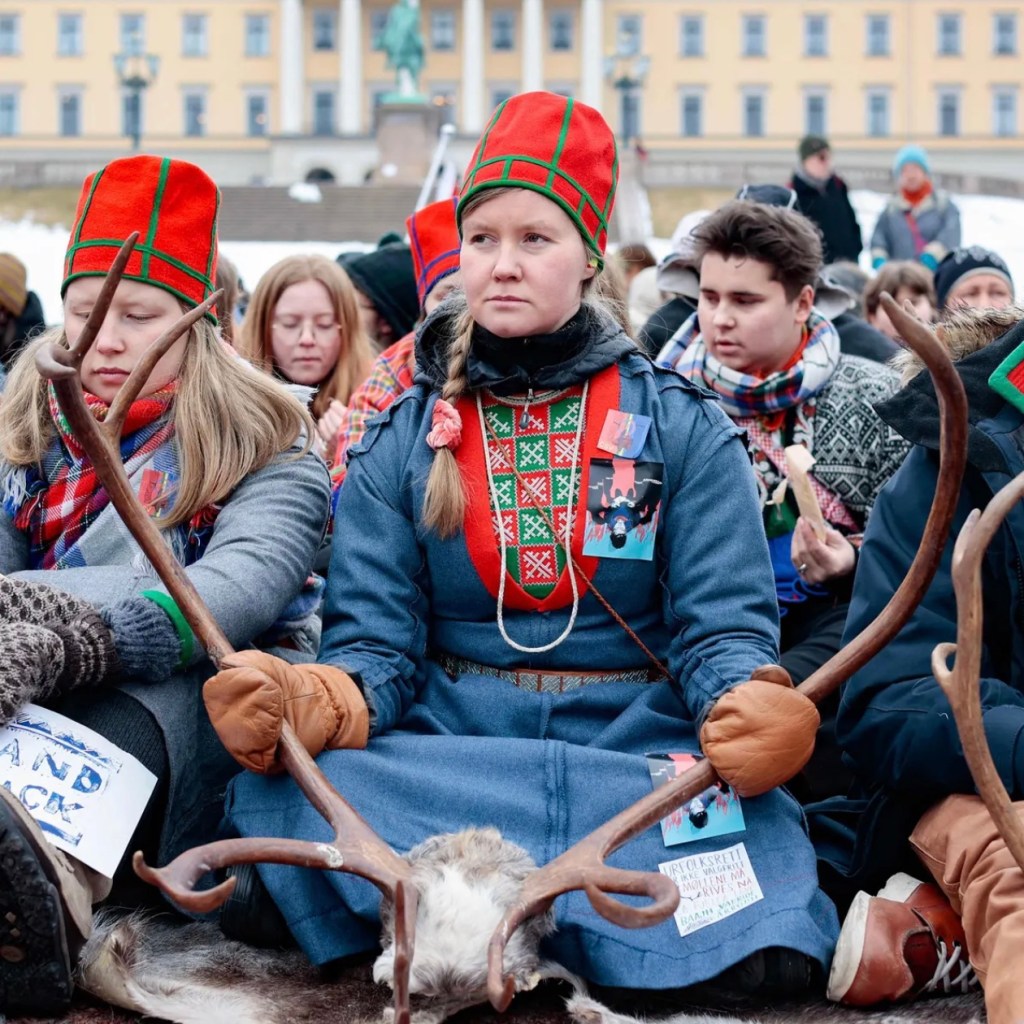
Truth & Reconciliation in Norway

Members of the Sámi community protesting against the building of wind turbines on land traditionally used to herd reindeer in Oslo, Norway, in March. Photograph: Alf Simensen/NTB/AFP/Getty Images

Friends in Norway are posting on Facebook about the final report of the Truth & Reconciliation Commission released today. The report is the culmination of five years of work by a commission of 12 professionals (I am proud to claim one as a relative, whom I met by chance in Sortland last summer). Their mandate was to document Norwegianization policies and injustices towards Sámi, Kven and other ethnic groups, and to propose measures for further reconciliation. More than 760 people provided testimonials.

Dagfinn Hoybraten, head of the commission, acknowledged that some outside observers may question the need for such a commission in a “welfare society characterised by peace and democracy”.

“The truth is that also Norway doesn’t have a history to be proud of when it comes to the treatment of our minorities.”

The live reading of the report (broadcast from the National Theatre) is no doubt evoking anger, grief, validation, and skepticism among many Norwegians.

On the positive side, there are no calls to ban the reading, to deplatform the Commission, or to enact laws that prohibit the teaching of this difficult history, lest it make majority kids feel “uncomfortable.”

But reconciliation is remote until Fosen is fixed.

In 2021, Norway’s Supreme Court ruled that the windfarms at Fosen, opposed by the Sami, were improperly permitted and constitute a violation of human rights. Earlier this year, after protests in Oslo shut down ministries and drew international solidarity, government officials apologized, admitted the violations, and promised swift action on the Fosen.

Yet those windmills keep on turnin’.

Saturday, June 3rd marks 600 days since the court ruling.

Sámi and allies are gathering now in Oslo, meeting the state’s empty words with their concrete action.

I wish them courage and endurance.

(Follow the group Natur og Ungdom on Instagram or Facebook for updates.)

Oh, to be there now!

Two years ago this month, at the last “live” Jokkmokk winter market, I recall standing in front of a display case of silver spoons in the Áttje Museum, struck by the thought that silver was a red thread through my ancestral history.

It can be traced from the 1600s when silver was found at Nasafjell, where soldiers, convicts, and Sámi were forced to work. In 1659, Norway destroyed the mine. In 1772, Karl Laestadius goes to work at the mine as an “executive” — perhaps a bailiff or sheriff of sorts — who has to pursue those who flee. (One of those who did not flee was my ancestor Olaf Tomassan Fannj.) The mine failed and Karl took up drink and farming. His son Lars Levi became the charismatic reformer of Karesuando who preached against vanity and wealth. His followers melted silver jewelry into cups and spoons. (His brother Per Laestadius estimated in 1839 that a silver belt was worth 15-20 reindeer!). The red thread continues to my Laestadian father in 20th century America, forbidding his daughters to wear make-up or jewelry, but giving his last baby girl a silver “teething” bell, which I still cherish.

If I could teleport to Áttje today, I would no doubt have similar aha! moments at the new “Mijá árbbe” exhibit, which features some of the 480 Sámi artifacts whose ownership was recently transferred from Etnografiska Museet.

This is not a geographical move as they were already there, on loan, but a victory nonetheless. Imagine having to seek permission from Stockholm each time you want to exhibit or study an item in your own archive.

Unlike Norway and Finland, Sweden has no national Sámi museum, and lags behind in the return of artifacts.

More details here.

https://www.svt.se/nyheter/sapmi/stor-samisk-samling-till-s-pmi-det-kanns-fantastiskt?fbclid=IwAR1cXvOHLXoD_MU-B-KTFQez9bwnS18rYTIOWehhl93yYUi1POFSz2Cdq_0&mibextid=Zxz2cZ

Fortunately with friends at the market, I will get to enjoy it virtually. Post those pics!

Jokkmokk Market 2019

Black Butterflies

We don’t watch shows together often but we make exceptions for holidays — and when someone is ailing. Last week as a birthday treat we watched Paddington Bear 2, which was absurdly fun, and so like our quirky youngest to suggest.

Last night I used my convalescence to cajole both husband and son (his sister is back at college) to watch a show together. I chose this compelling short documentary about the “Green Revolution” and Gállok.

It was important for me to share with our son that, at his age in the 1660s, our ancestor Olaf Thomassen Fannj (whose name may be a variant of “fanahit,” stretched, or “fadnu,” a flute made from the stem of angelica), was a slave. He was conscripted by the Swedish state to work in a silver mine in Gällivare, to haul ore with his reindeer.

The conditions were dreadful and the penalties severe (e.g., repeated submerging in a frozen lake). The road to the mine was, they say, lined with bones for a long time.

One source says:

To avoid forced labor, many Sami moved away, and when the government’s tax collector came to Kaitum in 1667, he wrote that “all had escaped,” and that there was no tax to collect. At the same time, in neighboring Sirkas, there were only nine taxpayers left. As a comparison, in 1643 Sirkas and Kaitum, which by that time were treated as one unit in the tax records, had had about seventy registered taxpayers. In 1667, the Sami population in the whole of Lule lappmark had decreased drastically and by then only fifty-five people were registered in the tax record.

According to Hultblad there were almost 200 taxpayers a decade earlier. The stress that the mines evidently brought on the Sami population was not in line with the government’s intention for interior northern Sweden, and policies had to be revised. From 1670, the number of people registered in the tax records slowly and steadily increased again, but it was not until after the tax reform in 1695 that the increase gathered real momentum.”

At 13:53, when Sara began to sing Sámi eatnam, I imagined Olaf — a young man with wind-whipped cheeks — loading his sledge with rocks, then stopping, suddenly alert, listening.

He is a slave in a Swedish colony, and a soldier is approaching, snapping a length of rope. But he has heard a sweet voice from the future.

Sámi dutkama máttut in: Indigenous Research Methodologies in Sámi and Global Contexts

Knowing about genealogies is a vital part of the Sámi cultural heritage, the conceptualization of history and Sámi identity. Genealogy in general traces lineages of kin relationships back in time. In Sámi, there is no one single term for genealogy, as for example whakapapa in Maori, probably because the traditional Sámi conceptualization of kinship relations is not linear, but instead covers an extensive network of multiplex relationships between ancestors referred to by the collective noun máttut (in the plural) in Sámi. The Sámi understanding of a genealogy is therefore more like a seine fishing net with hundreds of important net cells, covering all the lineages of the extended families, in a holistic multilevel totality with many branches.
— Read on brill.com/display/book/9789004463097/BP000003.xml