Mu Eadni / Mother of Mine

It’s a scary time. 

International law? Unenforceable. Convicted felon for president? Probable. Rollback of women’s rights? Happening.

As fascism bares its teeth, we must not take for granted the freedoms we’ve gained. They can be lost in one election. 

Those are my thoughts as I listen on repeat to this beautiful song by Mari Boine. I feel my heart slow. It is good medicine for those of us with a mother wound, recent or ancient, which is, I suppose, all of us.

In the introduction (below), Mari explains that her mother was a Laestadian Christian. For those yet unfamiliar, the faith is named for its 19th century Swedish Sámi founder, Lars Levi Laestadius, who finally succeeded in Christianizing the Sámi, or so it is said, after hundreds of years of failed missions. But it was not so simple.

Long before “woke” meant “aware of historical oppressions,” Laestadians referred to themselves as “the awakened”: aware of an embodied, transformative experience of the Divine not available through performative religion. Colonial power dynamics remained, however, shifting from male priests to male lay preachers, while principles like simplicity and moderation hardened into performative taboos. My own Laestadian mother, who died in 2021, never wore makeup or jewelry (other than a wedding band), never had her hair cut or styled, never saw a film, concert, or ball game, never played an instrument, never tasted wine, never heard a woman preach, never had her own bank account. Married at 17, she had nine children, and when her daughters chose different paths, she was profoundly hurt. I l often wished that I could free her, like a bird from a cage, and I suspect she felt the same about her mom, whose life was even more restricted.

Would Mari’s mom have attended her concerts had she been able to do so in disguise, without her Laestadian community punishing her for it?

Perhaps, in a way, she is at every performance, as transported as the rest of the audience, free to be carried away by beauty. It’s a lovely thought, and while I’m at it, I’ll place my mom, her distant relative, alongside, smiling and swaying.

Bravi tutti, Mari Boine and band, Knut Bry for the videography, Vojta Drnek for the editing, and Outi Pieski for the amazing art. Great work. (I am chuffed that my translation is captioned.)

Introduction

Mu eadni / Mother of Mine is a song of love and lament for the woman who gave me life, and for all women who suffer under systems that shame and subordinate them. As a Laestadian Christian, my eadni was bound by strict gender roles, and that insidious association of the feminine with sin. She was taught to be self-denying: that her highest purpose as a woman was obedience. (To males, naturally, all the way down.)

When her daughters resisted, she felt it was a personal failure. And yet, she was Sáami, with echoes and stirrings from a much older worldview, one that celebrated the feminine, that found purpose in reciprocity, not hierarchies. Sometimes, I feel her with us, free from shame, sharing our freedom. Smoothing our fringe. Adjusting our belts. Asking us to twirl.

Mari Boine

Mu Eadni 

You were not permitted to preen

Not for you the silken liidni

Nor were you allowed to dream

Of glamour, or vainglorious gákti

Feminine desire you had to condemn 

You could not defend even your own daughters

For pleasures of the flesh

Could open the soul to sin

O mother of mine, mother of mine

If I could draw you close again

I would swathe you in silk and pearls

Ribbon you in silver and gold 

Adorn you and adore you

So we three daughters, free

Could recall you to unshamed joy

You were not permitted to preen

For pleasures of the flesh

Could open the soul to sin

My mother, O my mother

Our mother, O our mother


Inka, August, Joonas

Recently, while researching a relative’s name online, this lovely 1926 film popped up: Med ackja och ren i Inka Läntas vinterland (With Reindeer and Sled in Inka Länta’s Winterland).

The course of events revolves around the young Sámi girl Inka Länta in her environment. The the arrival of Laestadian pastor August Lundberg stirs up emotions when his moral preaching goes too far.

A/V Club

(This version is only half as long as the original; let me know if you find a longer cut.)

Curiously, the relative I was researching, Joonas Purnu (1829-1902), was not in the film. But AI knows things, so I cast a wider net.

Bingo.

August Lundberg (1863-1930) who plays himself in the film, was rival of Purnu’s. Both men were lay preachers and became the godfathers of the two main Laestadian factions, Eastern (Lundberg) and Western (Purnu)—in a schism that launched many schisms, most recently in Wolf Lake, Minnesota. (The split that keeps on splitting.)

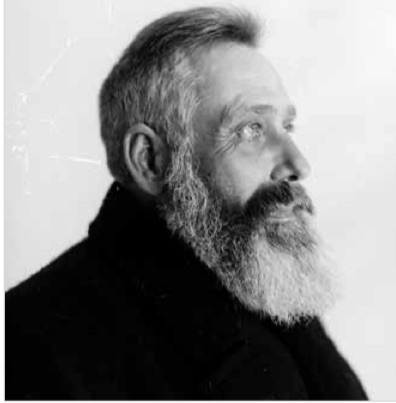
August Lundberg (1863-1930) by Borg Mesch

Tremors of the impending schism compelled Joonas Purnu to visit the USA in 1893, to calm the waters among Laestadian immigrants. This was also the year my morfars far Erik left Tärendö for America. At some point he visited the harness shop of his daughter Lina and her husband Oskar Walsten in Henry, South Dakota.

On left, Lina Walsten and her dad, Erik Wilhelm Lindberg, Henry, SD 1890s

Did Erik and Joonas travel together? They were relatives after all (not via Purnu from Sjokksjokk sameby, though—as Purnu was a farm name for Joonas—but via mutual Heiva ancestors from Siggevaara sameby).

Yet to be discovered.

Both men returned to Sweden.

August Lundberg was a generation younger than they, and Swedish, not Tornedalen with Sámi roots. Born in Dalarna and educated in Uppsala, August came north in 1885 to lead a Sámi mission school in Lanavaara. He married into the Laestadius family, no doubt an important factor in his success as a preacher.

A friend in Finland has copies of letters between Lundberg and my Purnu relative, Syster Mia Carlsson of Kiruna. Translated, they may help me understand the schism that continues to reverberate among descendants.

Economics played a role, e.g., Joonas Purnu forbade his followers to join unions.

To be continued . . .

Black Butterflies

We don’t watch shows together often but we make exceptions for holidays — and when someone is ailing. Last week as a birthday treat we watched Paddington Bear 2, which was absurdly fun, and so like our quirky youngest to suggest.

Last night I used my convalescence to cajole both husband and son (his sister is back at college) to watch a show together. I chose this compelling short documentary about the “Green Revolution” and Gállok.

It was important for me to share with our son that, at his age in the 1660s, our ancestor Olaf Thomassen Fannj (whose name may be a variant of “fanahit,” stretched, or “fadnu,” a flute made from the stem of angelica), was a slave. He was conscripted by the Swedish state to work in a silver mine in Gällivare, to haul ore with his reindeer.

The conditions were dreadful and the penalties severe (e.g., repeated submerging in a frozen lake). The road to the mine was, they say, lined with bones for a long time.

One source says:

To avoid forced labor, many Sami moved away, and when the government’s tax collector came to Kaitum in 1667, he wrote that “all had escaped,” and that there was no tax to collect. At the same time, in neighboring Sirkas, there were only nine taxpayers left. As a comparison, in 1643 Sirkas and Kaitum, which by that time were treated as one unit in the tax records, had had about seventy registered taxpayers. In 1667, the Sami population in the whole of Lule lappmark had decreased drastically and by then only fifty-five people were registered in the tax record.

According to Hultblad there were almost 200 taxpayers a decade earlier. The stress that the mines evidently brought on the Sami population was not in line with the government’s intention for interior northern Sweden, and policies had to be revised. From 1670, the number of people registered in the tax records slowly and steadily increased again, but it was not until after the tax reform in 1695 that the increase gathered real momentum.”

At 13:53, when Sara began to sing Sámi eatnam, I imagined Olaf — a young man with wind-whipped cheeks — loading his sledge with rocks, then stopping, suddenly alert, listening.

He is a slave in a Swedish colony, and a soldier is approaching, snapping a length of rope. But he has heard a sweet voice from the future.

Sámi dutkama máttut in: Indigenous Research Methodologies in Sámi and Global Contexts

Knowing about genealogies is a vital part of the Sámi cultural heritage, the conceptualization of history and Sámi identity. Genealogy in general traces lineages of kin relationships back in time. In Sámi, there is no one single term for genealogy, as for example whakapapa in Maori, probably because the traditional Sámi conceptualization of kinship relations is not linear, but instead covers an extensive network of multiplex relationships between ancestors referred to by the collective noun máttut (in the plural) in Sámi. The Sámi understanding of a genealogy is therefore more like a seine fishing net with hundreds of important net cells, covering all the lineages of the extended families, in a holistic multilevel totality with many branches.
— Read on brill.com/display/book/9789004463097/BP000003.xml

Only connect

Kalix River (svensk: Kalix älv, meänkieli: Kainhuunväylä; davvisámigiella: Gáláseatnu), July, 2016

“We steal from out descendants because we’ve forgotten our ancestors” is increasingly heard in discussions of climate collapse and adaptation. The myth of the bootstrapping, solitary individual has been a destructive one.

Five years ago, my dream of walking in my ancestors’ footsteps came true when my cousin Jeanette and I travelled through Sápmi. This video was taken around midnight, in my grandfather’s home village of Tärendö. (“Tear-in-two,” Mom called it. What I thought was Freudian for heartbreak turned out to be close to the local Meänkieli dialect.)

Grandpa was the last of his family to leave in 1903, so we didn’t expect to find any relatives in Tärendö. All ties to America came from other villages, where the family scattered long ago, so we were surprised when our hosts, Inge and Lasse (referred by a mutual friend) not only recognized our family surnames but shared a few of them.

Inge said, Heinonen? We are related, then!

Lasse drew a chart that showed how our great-grandfathers were cousins. Both men had changed their Sámi surnames to Swedish, hoping, perhaps, to keep old traumas from our shading our futures. (If only!)

Lasse gave me some papers from the Swedish government granting him permission to herd reindeer and own his earmark. When I tried to give them back, he said no, you take them. I’ve thought a lot about those papers, and the rights by which the state assumed its authority, and Lasse’s wry smile. So much to unpack.

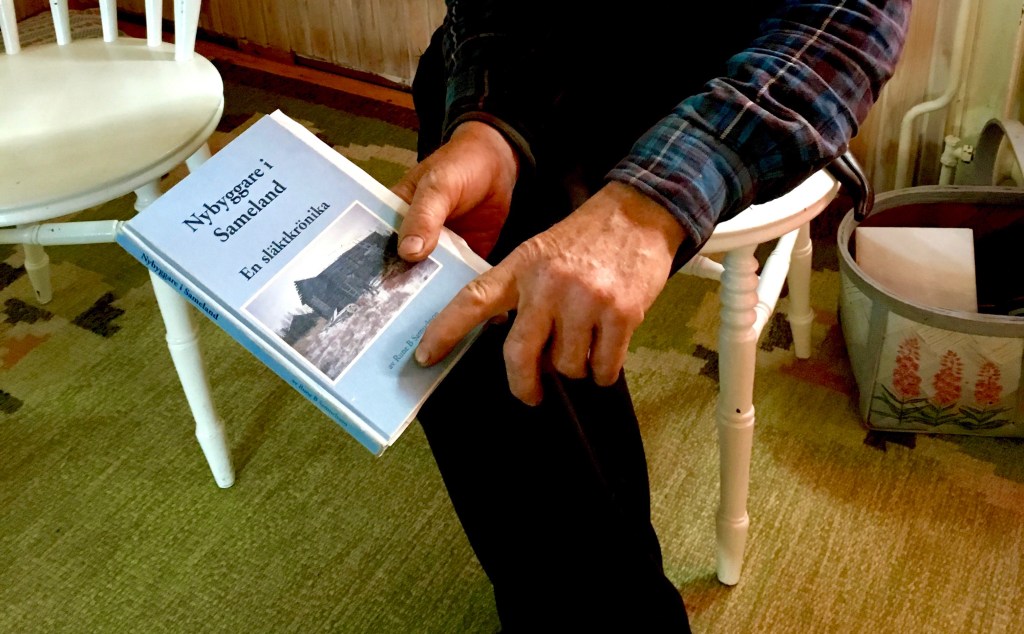
Lasse’s book with our ancestors’ names. July, 2016

But I want to tell you about this bridge. When it was under construction in 1938, they began by installing the arches. Before the roadway was laid down, an old lady from the village decided to cross. She was seen climbing up one of the arches, her tiny form doubled over, making progress one step after another. She clambered all the way up and over, and down the other side.

Maybe she was eager to see a friend on the other side?

“Now the kids do it for fun,” said Inge. Or maybe it was Lasse who told that story.

And maybe my leg was being pulled, in true Sámi fashion. But I prefer to think that the story is true, that the old lady was a relative — and that I inherited her pluck.

“Traveler, there is no path, but what you make by walking.”

“Only connect.”

Bridge over the Kalix, July 2016

Linneaus, Punk’d

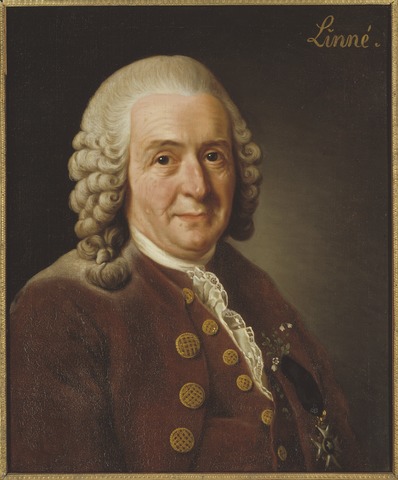
Carl von Linné, 1707-1778 by Roslin Alexander

I am inclined to believe that Linneaus was made fun of . . .

It is a well known fact that informants might get tired of the anthropologist’s endless and sometimes in their eyes nonsensical, questions. They then can tell the unhappy researcher what comes to their mind to satisfy him and to amuse themselves. I am inclined to believe that Linnaeus, too, was made fun of, without him being aware of it. After having been in Tjåmotis on his way back to Luleå, he describes, among many other things, the way the Sami kill a reindeer. He then mentions all the useful slaughter products the animal supplies them with. In the end we read: “Everyone throws the testicles away. The penis serves to make a thong to draw the sledges.

Though no comment is given on this, either in the general text commentaries or in the ethnological commentary on Linnaeus’ diary published in 2003, I have my suspicions that Linnaeus here was fooled. Although he told Roberg that he had travelled by sledge, no traces of it are found in the diary. The harness for drawing sledges he saw himself and described, when he was in Lycksele, had a leather thong. Motraye, who did travel by sledge and describes both sledge and harness, never mentions such a thing, talking only about “a trace”/”un trait”. From a publication of Knud Leem from 1767 we know that this thong was made of a strap of cow skin or seal skin, well greased to make it supple.

Nellejet Zorgdrager in Linnaeus as Ethnographer of Sami Culture, TijdSchrift voor Skandinavistiek vol. 29 (2008)

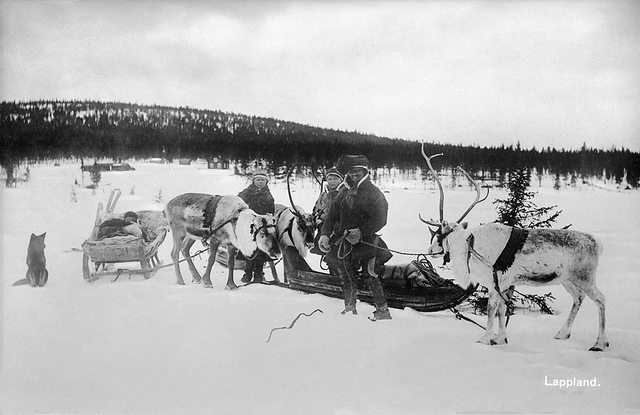
Jukkasjärvi Sámi family with sledge and reindeer, photo by unknown, Almquist & Cöster postcard 1949. Swedish Heritage Board. Public Domain

Travels in Sápmi

Laura Ricketts (2)Having corresponded briefly by email, I can hardly wait to meet Laura Ricketts in October, first at the Nordic Knitting Conference, where she is teaching and giving the keynote, and then at the Swedish Club, where she’ll talk about her travels in Sápmi, hosted by Pacific Sámi Searvi (I’ve joined the board again). Laura is the author of the e-book Discover the Wonderful World of Sámi Knitting and has published about Sámi knitwear extensively (you can find several patterns on Ravelry, including my favorite: the Jokkmokk flowers). Faith Fjeld, the beloved Sámi-American who launched the journal BAIKI, said an article by Laura helped make the July 2013 issue one of the most popular. A history teacher who has lived in Siberia and Mongolia, Laura experiences and insights will engage even the non-knitters among us. So bring your mates and kids.

The event is free, so no tickets are needed, but as I’m bringing the refreshments, please reserve your seats so I can get a headcount. Thanks! Hope to see a lot of folks there.


Swing and Joik

I enjoyed this recent post by Mauri Kinnunen about a 1937 article in the Chicago Daily Tribune, in which joiking is compared to swing music, and cocktails prove disappointing to some Swedish Laestadians. It may be a stretch to compare joik to swing, but both are characterized by energy and improvisation.

Go read the article, then come back and enjoy these clips.

Instrumental “cocktail swing” recorded in Sweden in the same year as the article, 1937:

The amazing Marie Boine inhabits this spine-tingling “Goaskinviellja / Eagle Brother” at the Oslo Opera House in 2009: